The Collapse Is Near
Scientific Game Jam Montréal 2025
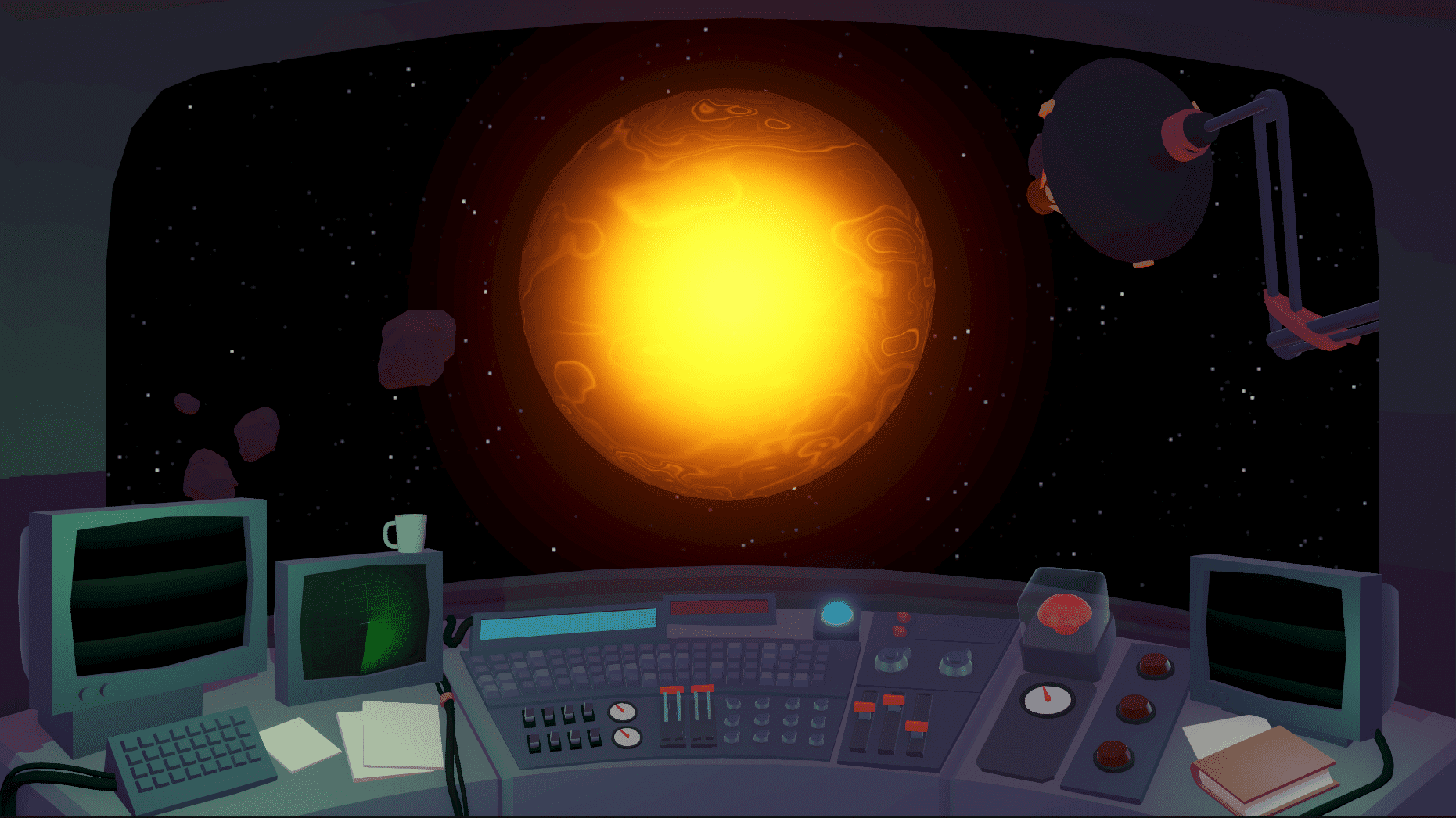
I had the incredible opportunity to take part in the Scientific Game Jam of Montréal 2025, held at Indie Asylum (an organisation that brings together several independent studios). We were a team of five, and together we created The Collapse Is Near. As with every team, our starting point was a scientist's research, and we were lucky to work with Emmanuel Calvet, a researcher and developer who studies the balance between order and chaos in complex systems. His work focuses on how this balance could enable more efficient neuromorphic circuits capable of processing vast neural networks while consuming far less energy than current technologies. The idea that a system can only survive by avoiding extremes strongly inspired us.
From there, we imagined an unstable sun constantly pulled between Order and Chaos. The player influences its state by typing messages on the keyboard: each message shifts the sun's state, which reacts by stabilising or spiralling out of control depending on what is sent. If an extreme is reached, the sun eventually explodes or collapses, ending the game. The entire experience rests on this constant tension, this attempt to maintain a fragile balance in a system that is always on the verge of tipping. The sun responds visually to the player's messages, creating a strange and almost meditative dialogue where one plays as much with the system as with one's own way of writing.
If you want to learn more about the calculation system behind the game, I invite you to read the explanatory page written by our scientist. He explains it far better than I could.
The jam lasted two days and we struggled to get started at first. We could not find a concept that was both engaging to play and faithful to Emmanuel's research. We spent most of the first day discussing ideas and only began development late in the afternoon, with the game presentation scheduled for 6 PM the following day. Given that difficulty, I am especially proud of the game we managed to produce.
On this project, I was responsible for coding part of the gameplay. Emmanuel handled the entropy calculation, and I made sure that system interacted correctly with the sun. I also coded several visual effects, such as the small red and green central bar that must stay in the middle to stabilise the sun (built with an HLSL shader). Too much green indicated an overexcited sun, too much red a sun that was too calm. I also programmed some button animations for the player's console (animations written entirely in code), and adjusted the triggering of the wave VFX created by one of my teammates.
At the end of the jam, we presented our game before a jury, and a public playtest session was organised a week later. Teams were allowed, if they wished, to improve their games between the jam and the playtests. The demo video above shows the version submitted at the end of the jam. Given the difficulties we encountered at the start, several elements we had planned were never integrated due to time constraints. For example, our game had a lose condition, the sun explodes when you can no longer stabilise it, but no win condition. There was no way to make the sun fully stable. We therefore continued development. We added a win condition (which I handled), a few visual elements (such as a graph showing the player's click entropy in real time), explanatory menus and a credits screen to acknowledge everyone who contributed to the project.
Windows builds of all versions of the game are available on our itch.io page.